.png&w=3840&q=75)




.png&w=3840&q=75)

.png&w=3840&q=75)




UAE Real Estate Laws and Regulations: Market Trends and Investor Rules for Dubai, Abu Dhabi, and Sharjah
UAE real estate can look deceptively straightforward: attractive buildings, clear asking prices, and “rent it out” math that seems to work on the back of a napkin. The reality is that your outcome is shaped as much by regulation as it is by location. Escrow rules, registration requirements, ownership eligibility, and fee structures can quietly change your risk profile—and your net return.
This investor guide is written for beginner investors, expats buying their first income property, and high-net-worth buyers building larger portfolios. It focuses on practical questions (what you can own, how off-plan payments are protected, what fees reduce ROI, and what market trends matter right now). It is not legal, tax, or financial advice, and regulations can change.
Why the legal framework matters more than the brochure
In the UAE, “ownership” is not just a contract; it’s a registered right. The stronger your registration position, the stronger your enforcement position. That’s why the boring stages—title deed issuance, interim registration for off-plan, and approvals—are not admin details. They are the backbone of your asset.
For investors, the legal framework answers three money questions early: (1) can you own this unit type in this specific area, (2) how your money is protected while a project is being built, and (3) which unavoidable government fees reduce your net yield from day one.
Ownership rules for expats across the UAE
Foreign and expatriate buyers can generally acquire property in designated areas (commonly described as “investment areas” or “freehold zones”), but the exact map and the permitted rights are set at an emirate level. The practical takeaway is simple: always confirm that the specific building or project is in an approved area for your nationality and that your ownership right matches your plan (freehold vs long lease/other in‑kind rights).
Abu Dhabi, for example, has a formal concept of investment zones where non-citizens can acquire in‑kind rights over properties located within those zones. Sharjah has also expanded pathways for non-UAE nationals to own property, but the “designated area/project” concept still matters in practice—buying the right asset in the wrong place can leave you with a right you cannot register smoothly or resell efficiently.
A note for expats and HNW buyers: residency pathways linked to property ownership exist, but eligibility thresholds and documentation requirements can change. Treat residency benefits as a possible upside, not the core investment thesis.
Off-plan protections: escrow accounts and interim registration
Off-plan can be compelling in the UAE because staged payment plans can lower the immediate cash burden—and sometimes widen choice in new communities. But the risk profile is different from a ready unit: you are paying for a future asset.
In Dubai, the escrow account framework exists specifically to ring-fence buyer funds. In plain terms, payments from off-plan purchasers and financiers are deposited into a project escrow account. The law expects the escrow account to be opened in the project’s name, dedicated to that project, and not mixed across multiple developments. It also includes governance requirements (for example, each project should have its own escrow account, and there are protections designed to preserve depositor rights if a project faces serious issues).
Alongside escrow, interim registration for off-plan sales is another investor checkpoint. The goal is to record the off-plan sale in the relevant interim register, creating an official trail before final title deed issuance at handover. If you are buying off-plan, ask for proof of: (a) project registration/approval, (b) escrow account details for the specific project, and (c) your interim registration reference after signing the SPA.
Fees, taxes, and ongoing charges that shape real ROI
UAE property is often described as “tax friendly,” but investors still face meaningful transaction costs and running costs. Separate the concepts clearly:
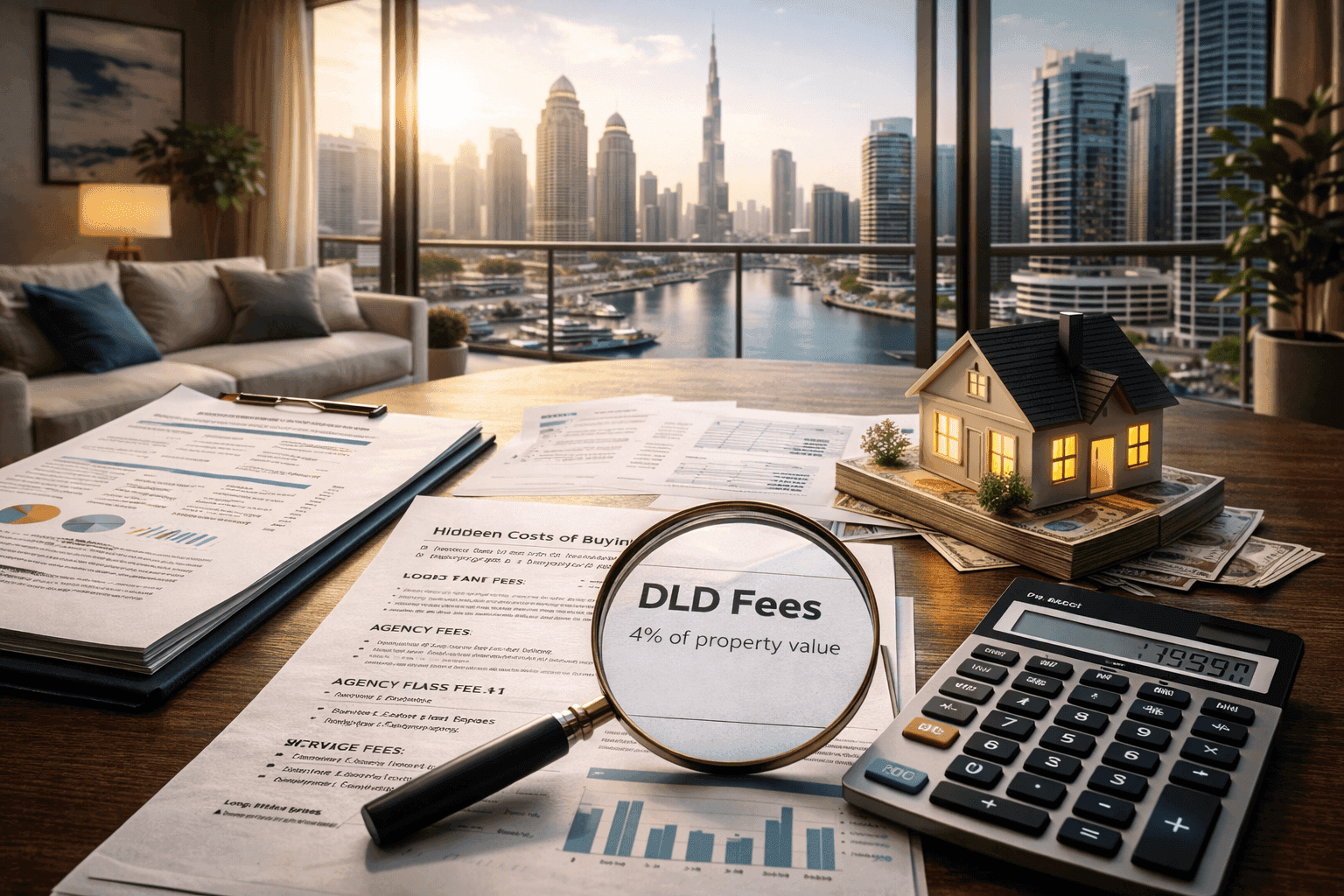
- One-time government fees on purchase/transfer. In Dubai, the transfer fee is commonly priced at 4% of the property value. Many transactions treat this as buyer-paid in practice, even if parties can agree otherwise. Abu Dhabi commonly applies a 2% transfer/registration fee on the purchase price (with some project-specific variations).
- Ongoing building costs. Service charges (common area fees), maintenance, and periodic upgrades can materially reduce net yields, especially in premium towers with extensive shared facilities.
- VAT and corporate tax context. VAT treatment depends on whether real estate is residential or commercial. Corporate tax considerations can become relevant if you hold assets through certain business structures, including some free zone scenarios. Individual investors should also consider tax rules in their country of residence, even if the UAE does not levy personal income tax.
The practical rule: underwrite net yield, not just gross yield. A unit showing an “8% gross yield” can land closer to 5%–6% net after service charges, maintenance, leasing costs, and realistic vacancy assumptions.
Market trends investors are watching right now
Recent market cycles have been defined by three themes: strong transaction volumes in major hubs, off-plan activity supported by payment plans, and a widening gap between mass-market yields and prime/luxury yields. Premium neighborhoods can be excellent long-term holds, but higher entry prices often compress rental yields; mid-market communities can offer stronger income metrics but need tighter tenant-demand analysis and cost control.
Dubai’s transaction activity has remained prominent in the region, with major market trackers reporting record levels of value flowing through the market. At the same time, analysts increasingly emphasize “micro-markets”: two neighborhoods can behave like different cities in terms of rent growth, vacancy risk, service charges, and resale liquidity.
Realistic ROI ranges investors use for underwriting
No two buildings produce the same return, but market-wide data and community-level reporting help investors set sane guardrails. Market averages suggest that UAE gross rental yields commonly sit in the mid-single to high-single digits, depending on emirate, asset class, and entry price. Some community-level snapshots show higher headline returns in value-driven districts, while prime areas often show lower yields (with a different risk/return mix).
For a reality check, take a property priced at AED 1,000,000 and assume annual rent of AED 65,000 to AED 80,000 (a 6.5% to 8.0% gross range). Then subtract service charges, maintenance, leasing costs, and a vacancy buffer to estimate net yield. That “net after reality” number is what you should compare across options—not the headline ROI.
Use disciplined language in your underwriting: “expected ROI,” “market averages suggest,” and “historically ranges between.” Avoid treating any brochure figure as guaranteed.
Practical compliance checklist for first-time and high-net-worth buyers
Use this checklist before paying a deposit or signing an SPA:
- Confirm the property is in an approved ownership area for your nationality and that the exact ownership right is clear (freehold vs long lease/other).
- Verify registration artifacts: title deed for ready property; interim registration reference for off-plan after signing.
- For off-plan: confirm the project has a valid escrow account in the project’s name, and match your payment instructions to that account.
- Underwrite all fees in AED: transfer fees, registration/admin fees, mortgage registration (if financing), and applicable VAT on services.
- Model net yield: include service charges, maintenance, insurance where relevant, management fees (especially for short-term letting), and vacancy assumptions.
- If buying via a company or a free zone entity, obtain specialist tax advice on corporate tax and VAT positioning; the correct structure depends on your facts.
- For larger portfolios: consider succession planning and documentation (for example, wills and ownership planning) appropriate to your circumstances.
Important disclaimer
This article is for general informational purposes only and does not constitute legal, tax, or financial advice. Regulations, fees, and eligibility rules can change, and implementation may differ by emirate and by project. Always verify current requirements with the relevant authorities and qualified professionals before making an investment decision.