.png&w=3840&q=75)




.png&w=3840&q=75)

.png&w=3840&q=75)




Rental Yields & ROI in UAE Real Estate: What Investors Should Expect in 2026
The UAE can look deceptively simple on paper: no “property tax” the way many countries apply it, strong tenant demand in key neighborhoods, and a market that moves fast. That’s exactly why rental yield headlines can be misleading. The number that matters is what stays in your pocket after fees, service charges, vacancies, and day-to-day realities.
This guide is written for beginner investors, expats buying their first rental, and high-net-worth buyers comparing prime locations. It focuses on practical ranges (not promises) and the UAE-specific costs that most people only learn after their first purchase.
Market Overview
Rental yields in the UAE vary sharply by emirate, community, and unit type. In Dubai, smaller units in mid-market, high-demand communities often price more efficiently, while ultra-prime addresses can deliver lifestyle and resale value but typically compress rental yield.
In 2026, investors should also keep an eye on rent regulation mechanics. Dubai’s official rent tools continue to shape what landlords can realistically achieve at renewal, especially when a tenant is already in place. That doesn’t “cap” the market, but it can influence your income trajectory compared to a vacant unit being leased at today’s market.
Main Section
Gross yield vs net yield (why “ROI” needs context)
In everyday conversations, people mix up “rental yield” and “ROI.” For most buy-to-let investors, rental yield usually means gross yield (annual rent divided by purchase price). ROI is often used loosely to mean the same thing, but a true ROI view should consider transaction costs, holding costs, vacancy, and resale assumptions.
Two practical reminders: service charges and management fees matter in the UAE more than many first-time buyers expect, and your results will differ depending on whether the unit is long-term leased, short-term/holiday-let, or kept flexible. Market averages suggest that the gap between gross and net returns can be meaningful, especially in premium towers with higher annual service charges.
| Area | Average Price | Expected ROI |
|---|---|---|
| Dubai Marina | AED 4,257,000 | 4.5–5.8% |
| Jumeirah Village Circle (JVC) | AED 1,245,000 | 5.5–6.8% |
| Business Bay | AED 3,674,000 | 4.6–5.5% |
| Downtown Dubai | AED 5,850,000 | 3.8–4.8% |
| Al Reem Island (Abu Dhabi) | AED 2,119,000 | 5.8–6.8% |
| Yas Island (Abu Dhabi) | AED 2,610,000 | 4.8–5.7% |
| Aljada (Sharjah) | AED 1,168,000 | 5.2–6.3% |
Note: The prices above reflect broad market averages from portal listing data, and the ROI ranges reflect typical gross-yield expectations from market averages. Unit condition, view, furnishing, building service charges, tenant profile, and vacancy periods can all push results higher or lower.
Cost Breakdown
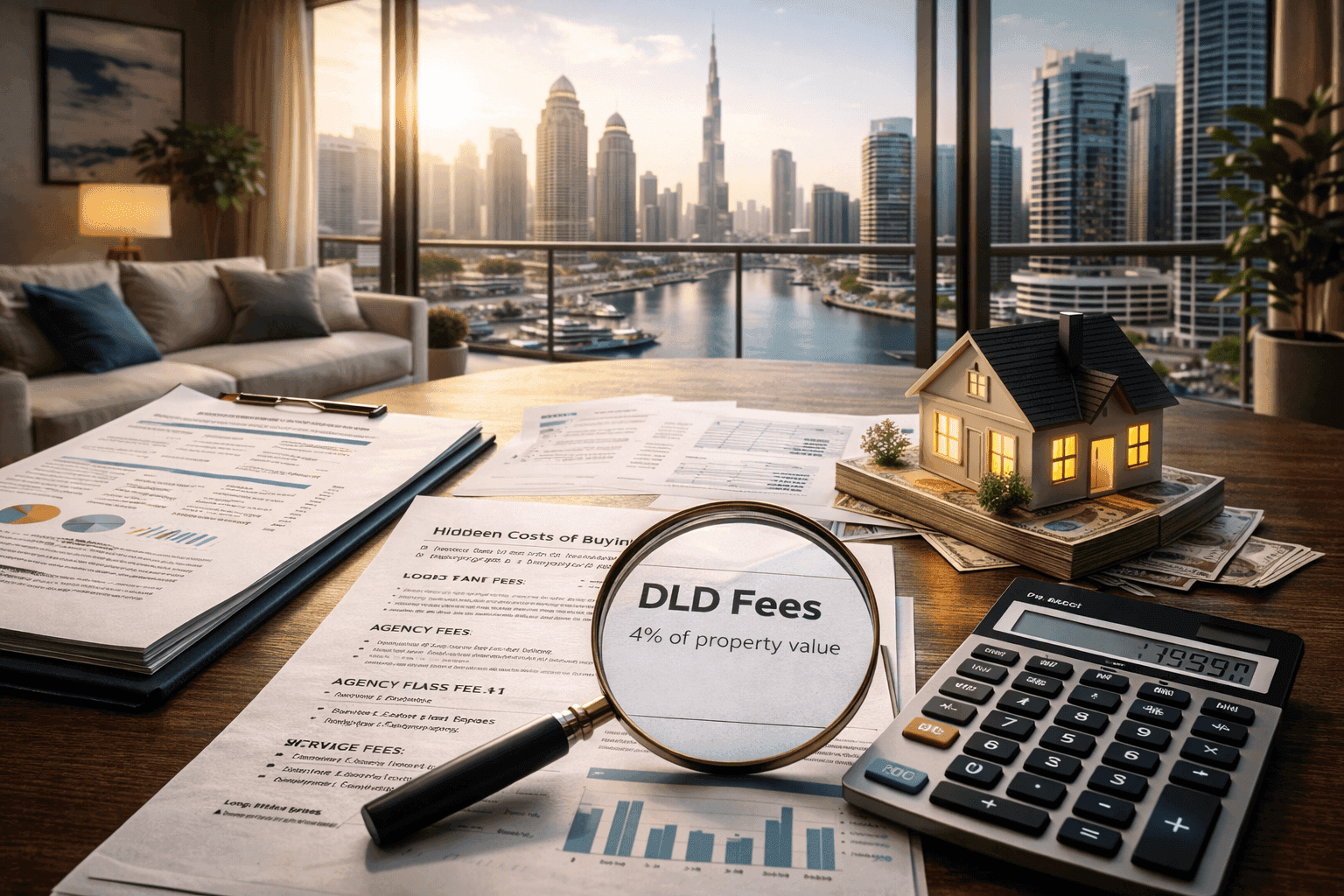
If you want a more realistic ROI view, start by separating one-time purchase costs from annual holding costs. In Dubai, the largest item is typically the 4% transfer fee, then broker fees, trustee/registration charges, and any developer NOC fees on resale units. If you buy with a mortgage, add the mortgage registration fee and bank-related costs.
In Abu Dhabi, transfer fees are generally lower than Dubai, but you should still budget for title deed/admin charges, broker commission, and building/community service charges. In Sharjah (especially in designated ownership zones), buyers also face registration/transfer-related fees, and those fee structures can differ by transaction type and whether special campaigns or discounts apply.
Typical investor budgeting buckets (indicative, not fixed): transfer/registration fees, broker commission, developer NOC/administration, annual service charges, maintenance reserves, insurance, and management fees (especially if you do not live in the UAE full-time).
Risks & Considerations
- Market cycles: Rental markets can cool or heat quickly. Stress-test your numbers with lower renewal increases, a vacancy period, or a rent reduction at re-lease.
- Developer reliability: Build quality, handover timelines (for off-plan), and ongoing building management directly affect tenant demand and maintenance costs.
- Liquidity considerations: Some units sell faster than others. Floor plan, views, parking, and building reputation can matter as much as the location pin.
Investment Strategy
Under AED 1M (entry-level): Many first-time investors prioritize studios or compact one-beds in communities with deep rental demand and a large tenant pool. The trade-off is competition and supply risk, so picking an established building and a practical layout matters.
AED 1M–3M (core investor range): This band often gives the best balance of liquidity and rentability. Investors can focus on buildings with reasonable service charges, strong transport access, and consistent leasing velocity.
AED 3M+ (prime and lifestyle-led): For high-net-worth buyers, the objective may shift: you might accept a tighter gross yield in exchange for long-term desirability, brand value, and resale depth—especially when the asset could also serve as a UAE base.
Additional Insights
If you want one “rule” to follow, make it this: calculate net yield using conservative assumptions. Build a simple spreadsheet with your expected rent (not peak rent), subtract service charges, management (if any), basic maintenance allowance, and factor in a vacancy period. Then compare that net number to alternatives in the UAE.
Also remember that tax and regulation details can change. VAT treatment differs between residential and commercial leasing, and corporate tax rules depend on whether you invest as an individual or through a company structure. For most investors, the safest approach is to use official sources for costs, taxes, and registration requirements before committing.
Disclaimer: Real estate investments are subject to market conditions. Returns are not guaranteed and may vary. This article is for general information only and is not financial, tax, or legal advice. Regulations and fees may change over time.