.png&w=3840&q=75)



.png&w=3840&q=75)

.png&w=3840&q=75)



UAE Real Estate Market Trends 2026: Investor Guide to Dubai, Abu Dhabi & Sharjah
In the UAE, the headline number is never the whole story. A smart property decision in 2026 comes down to three things: where end-user demand is strongest, what your expected gross yield looks like after fees, and how quickly you can exit if your plan changes. This guide is written for beginner investors, expats, and high-net-worth buyers who want a clear, UAE-specific view (in AED) without hype or guarantees.
Market Overview
Dubai entered 2026 with momentum, but also with a more measured tone than the peak excitement of 2025. Q1 2026 activity remained high by global standards, while the off-plan segment continued to lead deal flow. The key takeaway for investors is not “up or down,” but more selective: strong projects and well-located resale units can still attract liquidity, while weaker stock tends to sit longer.
Abu Dhabi is increasingly attractive for investors who want a steadier tenant profile and master-planned communities. Market data from 2025 points to meaningful transaction growth and a wider set of investable sub-markets, from yield-led mid-tier zones to premium lifestyle addresses.
Sharjah remains the affordability-driven story, supported by cross-emirate living and a value proposition that appeals to cost-sensitive tenants. For investors, Sharjah can work when the underwriting is disciplined: focus on building quality, parking and access, and realistic exit timelines.
Main Section
Dubai trends investors are watching in 2026
Dubai is still an “investor market,” but the centre of gravity matters. Premium areas can deliver strong occupancy and brand value, yet yields can compress when prices outrun rents. Mid-market communities are often where the yield looks more compelling, but you need to stay strict on service charges, layout quality, and resale competition from new handovers. If you are considering off-plan, treat escrow verification and developer track record as a non-negotiable part of due diligence.
Abu Dhabi trends: yield plus tenant quality
Abu Dhabi’s pattern is distinct: several mid-tier island communities can offer appealing expected rental yields, while top-tier cultural and waterfront districts tend to trade at higher price-per-sq-ft levels with lower yields but stronger “lifestyle premium.” Investors often do best when they decide upfront whether they are buying for yield, for long-term capital preservation, or for personal use with a secondary rental option.
Sharjah trends: value-led demand with a different liquidity profile
Sharjah is not Dubai, and that is the point. Entry pricing can be dramatically lower, and certain neighbourhoods can show healthy expected yields. The trade-off is that resale liquidity may be thinner, and building-to-building variance is bigger. Investors should prioritise commute-friendly zones, well-managed towers, and conservative assumptions for vacancy and maintenance.
| Area | Average Price | Expected ROI |
|---|---|---|
| Dubai Marina | AED 2,085/sq ft | 5.5–6.8% |
| Downtown Dubai | AED 3,134/sq ft | 5.0–6.3% |
| Business Bay | AED 2,090/sq ft | 6.0–7.2% |
| Jumeirah Village Circle (JVC) | AED 1,455/sq ft | 6.5–8.0% |
| Al Reem Island (Abu Dhabi) | AED 1,352/sq ft | 6.5–8.2% |
| Yas Island (Abu Dhabi) | AED 1,818/sq ft | 6.2–7.8% |
| Al Nahda (Sharjah) | AED 524/sq ft | 6.3–7.8% |
Cost Breakdown
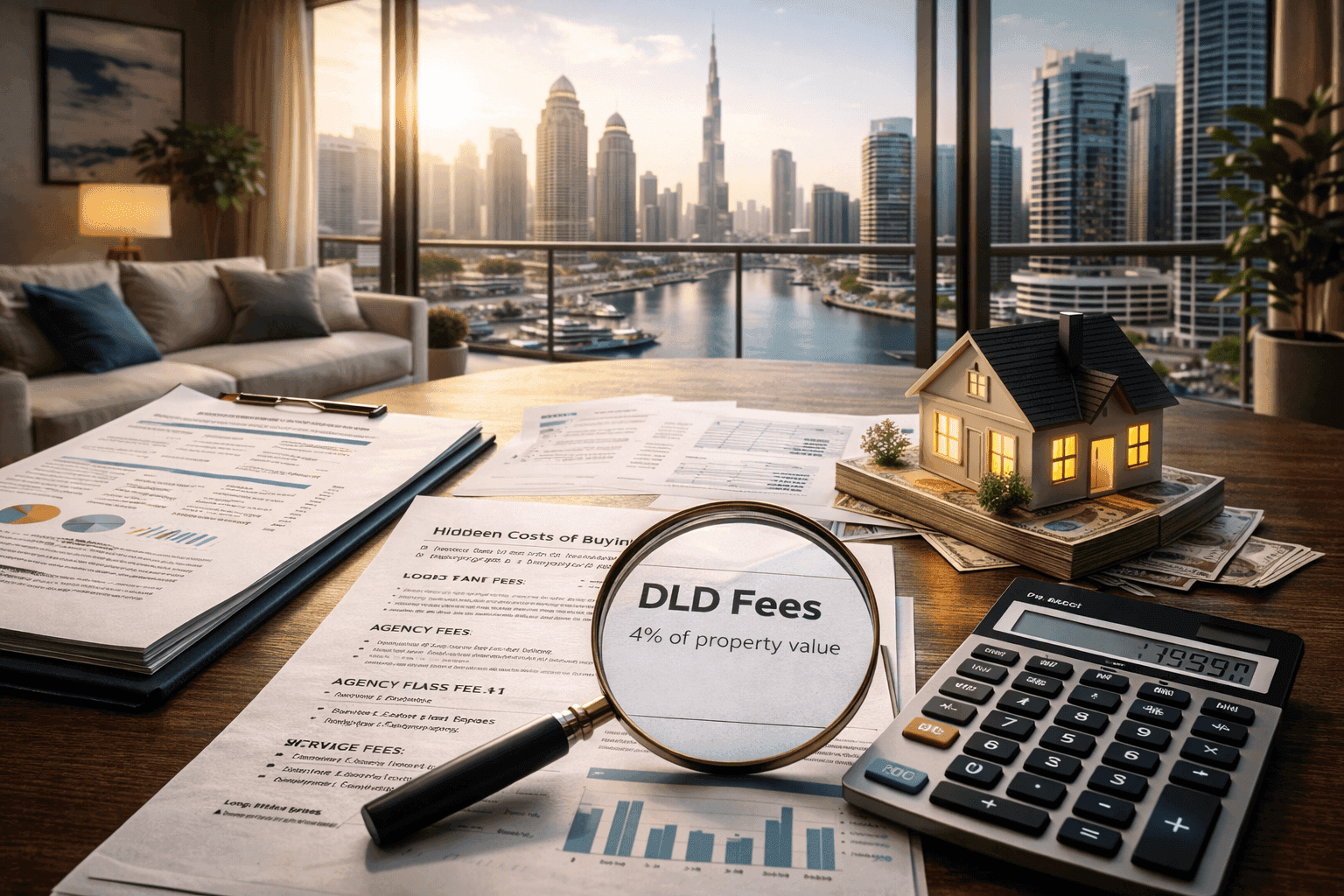
Dubai cost planning is where many first-time investors get surprised. Your “all-in” number is the purchase price plus government fees, trustee/service partner fees, agent commission, and recurring service charges. (Exact fees can change, and the final breakdown depends on whether the deal is resale, off-plan, or mortgaged.)
Typical Dubai buyer-side items to budget (indicative):
• Transfer/registration fee: structured as 2% seller + 2% buyer of the sale value (total 4%).
• Administrative items: title deed certificate issuance and mapping-related fees may apply; knowledge/innovation fees are also listed in DLD service schedules.
• Trustee / service partner fees: commonly AED 4,000 + VAT for transactions at AED 500,000+ (lower bracket fees can apply below AED 500,000).
• Mortgage registration (if applicable): 0.25% of the mortgage value (plus listed fixed items depending on the case).
• Broker commission (market norm): often around 2% of the sale price, with VAT applying to the service.
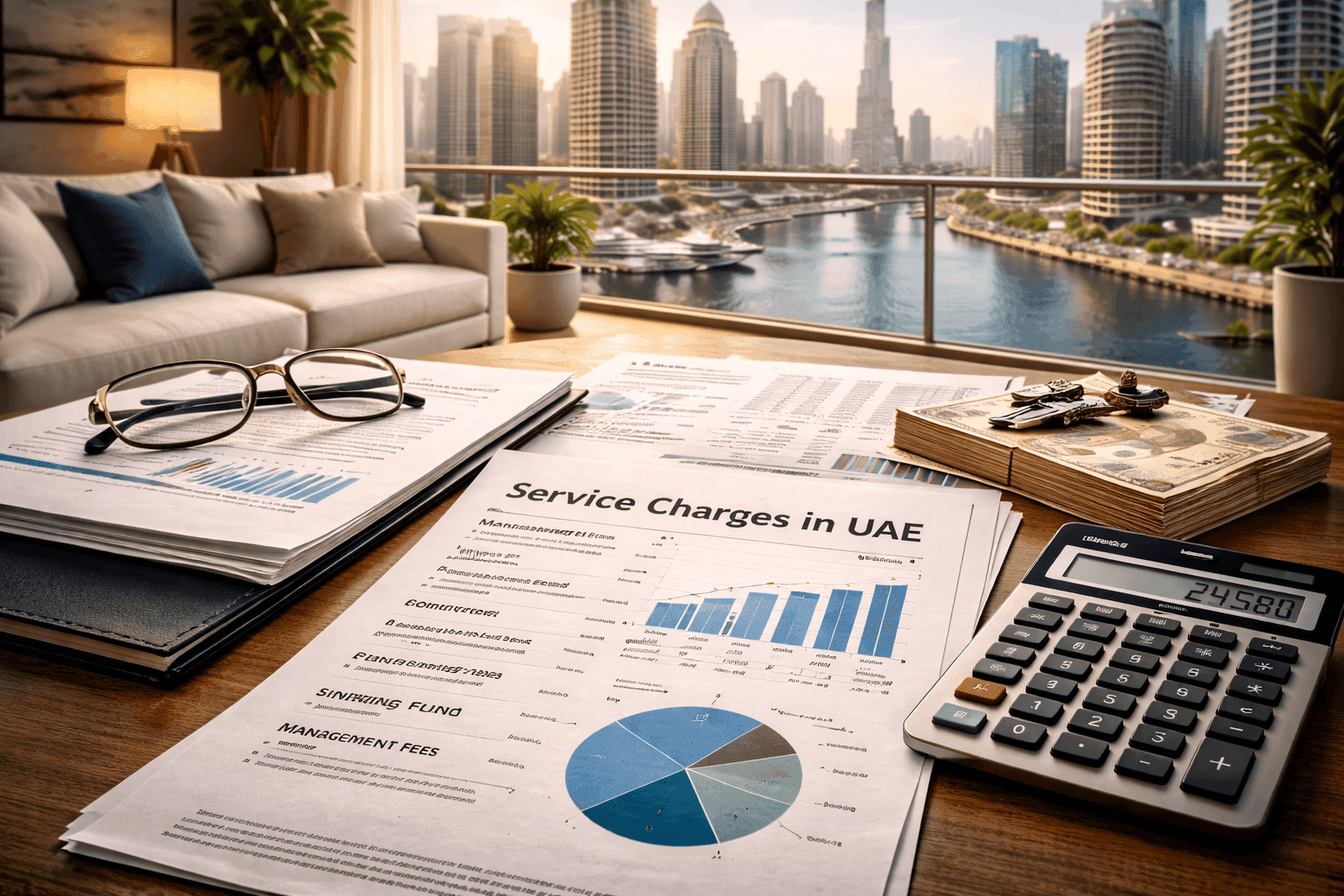
Ongoing UAE reality: Service charges are a core driver of your net yield. In Dubai, they are calculated per sq ft and vary widely by project and amenities. Investors can cross-check the approved rates via the DLD Service Charge Index and should underwrite with conservative annual allowances for service charges, maintenance, and vacancy.
Abu Dhabi and Sharjah (high-level orientation): Abu Dhabi fees commonly include a transfer/registration fee percentage, title deed issuance fees, agent commission norms, and mortgage-related charges when financing is used. Sharjah fees can differ by buyer category and transaction type, so treat any estimate as indicative and confirm with the relevant authority or trustee channel before committing.
Risks & Considerations
- Market cycles: The UAE is liquid and fast-moving, which is great on the way up and unforgiving if you overpay or underestimate competition.
- Developer reliability: Especially for off-plan, timelines, build quality, and escrow hygiene can materially affect outcomes.
- Service charges and net yield: A high gross ROI can compress quickly when service charges are elevated.
- Liquidity: Some units sell in weeks; others take months. Your exit plan should be realistic, not optimistic.
- Regulations may change: Fee schedules, rental rules, and ownership conditions can be updated. Always verify the latest requirements.
Investment Strategy
Budget: AED 500k–900k (entry-level, yield-first)
Many investors start here with studios or compact 1-beds in mid-market zones (or Sharjah commuter neighbourhoods). Your expected gross ROI can be in the mid-to-high single digits depending on the building, but the difference between a well-managed tower and an expensive-to-run one is everything.
Budget: AED 900k–2.5M (balanced portfolio approach)
This range can open more established Dubai communities and select Abu Dhabi island locations. Aim for “rentability”: practical layouts, strong building maintenance, and realistic service charge levels. If you are an expat investor, also stress-test your plan against currency movements and mortgage-rate changes.
Budget: AED 2.5M–5M (family end-user overlap)
Here, you can target larger apartments or townhouses where end-user demand is stronger. Expected yields may be a bit lower than strict yield plays, but stability and resale depth can improve if the community is genuinely livable.
Budget: AED 5M+ (prime, prestige, and capital preservation)
This is where “trophy assets” live. In prime districts, investors often accept lower yields in exchange for tenant quality, scarcity value, and long-term positioning. Underwrite conservatively and do not assume past appreciation repeats on schedule.
Additional Insights
Think in net, not gross. A clean underwriting model in the UAE is simple: estimate annual rent conservatively, subtract vacancy allowance, service charges, maintenance, and leasing costs, then compare the result to your true all-in acquisition cost (including fees). That net number is what your portfolio feels month-to-month.
Match the asset to your time horizon. Short holding periods amplify transaction costs and market timing risk. Longer holding periods make tenant demand and building management more important than “headline” price moves.
Stay compliance-minded. Use official trustee channels, verify the property status and required NOCs, and treat all fee schedules as subject to change. This article is informational and not legal advice.
Disclaimer: Real estate investments are subject to market conditions. Returns are not guaranteed and may vary.