.png&w=3840&q=75)




.png&w=3840&q=75)

.png&w=3840&q=75)




UAE Real Estate Investment Guide for Beginners: Dubai, Abu Dhabi, and Sharjah
UAE property can be a sensible first investment for beginners and expats if you treat it like a spreadsheet, not a lifestyle brochure. Your outcome is shaped by entry price, true running costs, and how easily the unit rents and resells. This guide focuses on investor basics with realistic ROI ranges (never guarantees).
Market Overview
Dubai remains the most liquid market and is still heavily influenced by off-plan activity. Recent research updates indicate 2025 stayed highly active, with off-plan sales forming a large share of apartment transactions and volumes concentrated in communities such as Jumeirah Village Circle (JVC) and Business Bay. Abu Dhabi also posted a strong 2025, with market reviews reporting sharp annual gains in residential values and rents. Sharjah is increasingly viewed as a value alternative, especially in master-planned communities that combine lower entry prices with steady end-user and rental demand.
On income, published market insights suggest Dubai rental yields average in the mid-6% range overall, with apartments typically higher than villas. Net yield (after service charges, maintenance, leasing costs, and vacancy) is usually lower than the headline gross number, so it is the better planning metric.
Main Section
Start with the right definition of ROI
In UAE reports, ROI usually means gross rental yield: annual rent divided by purchase price. For a beginner, the safer metric is net yield after costs. Two similar units can show the same rent, but the one with higher service charges can underperform meaningfully once annual costs are counted.
Pick a tenant engine first, then a property
Beginner-friendly buys are typically studios and one- to two-bedroom apartments in areas with year-round tenant depth. Community averages are a starting point, but buildings differ, so validate service charges and recent rental activity building-by-building before you commit.
| Area | Average Price | Expected ROI |
|---|---|---|
| Dubai Marina | AED 2,245,934 | 5.5–6.5% |
| Jumeirah Village Circle (JVC) | AED 996,498 | 7.0–8.0% |
| Business Bay | AED 1,892,749 | 6.0–7.0% |
| Downtown Dubai | AED 3,408,001 | 5.0–6.0% |
| Al Reem Island (Abu Dhabi, studio) | AED 797,000 | 7.5–8.5% |
| Aljada (Sharjah, 1-bed) | AED 747,000 | 5.5–6.5% |
Cost Breakdown
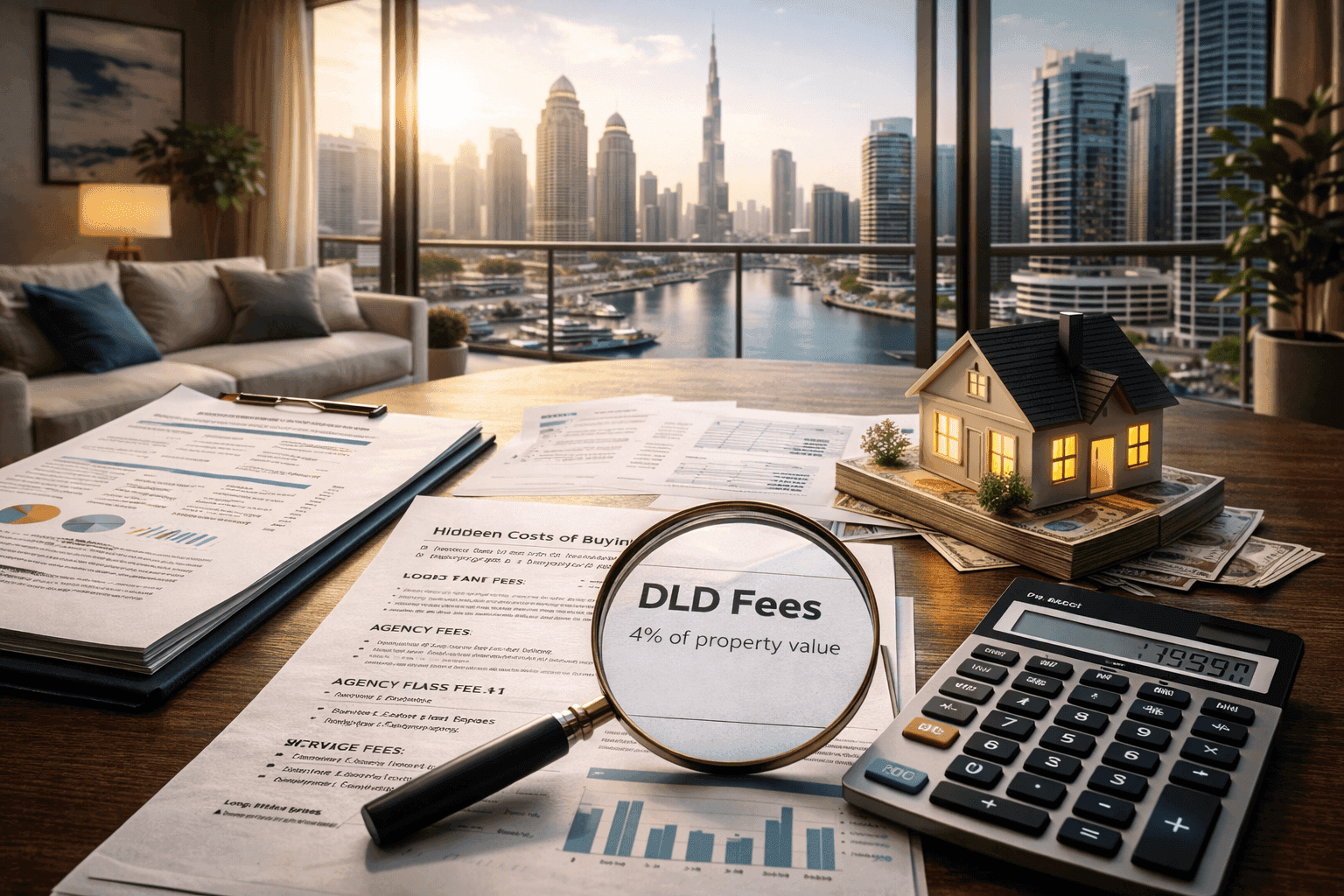
Dubai: The largest government cost is the 4% Dubai Land Department (DLD) transfer and registration fee (legally split, but commonly paid by the buyer in practice). Common additional items include trustee/registration fees (often AED 2,000–4,000 plus VAT depending on price) and title deed/admin charges. Using a mortgage can add a mortgage registration fee (often shown as 0.25% of the loan amount) plus bank valuation/processing fees. Broker commission is typically around 2% of the property price plus VAT on the commission, and developer NOC fees may apply depending on the building and transaction.
Abu Dhabi: Public service guidance commonly cites a 2% real estate registration fee (based on contract value) plus an e-services fee. If you register a mortgage, a separate mortgage registration fee may apply.
Mortgage planning: UAE Central Bank mortgage regulations set maximum loan-to-value (LTV) ratios. Published caps show expatriates at up to 75% LTV for a first home under AED 5 million and up to 65% above AED 5 million. For second/subsequent or investment properties, the published maximum is 60% regardless of value. For off-plan properties, the published maximum is 50%, and the published maximum mortgage tenor is 25 years. The regulations also state that down payments should come from the buyer’s own resources (not additional borrowing). Regulations and bank criteria can change, and a lender may approve less than the published maximum, so confirm current terms before committing. This is informational only and not legal advice.
Risks & Considerations
- Market cycles
- Developer reliability
- Liquidity
Investment Strategy
Under AED 600,000: Prioritize liquidity and tenant depth. Studios can work where service charges are controlled and the building has a proven rental track record.
AED 600,000–2,500,000: The classic beginner band. Focus on practical one- and two-bedroom units that rent quickly, then compare expected net yield across buildings, not just across areas.
AED 2,500,000+ and HNW: Prime assets often trade yield for location and long-term appeal. Underwrite conservative net yields, assume higher holding costs, and prioritize strong building management and maintenance standards.
Additional Insights
If a deal only looks attractive under optimistic rent growth, it is usually not priced defensively.
Disclaimer: Real estate investments are subject to market conditions. Returns are not guaranteed and may vary.